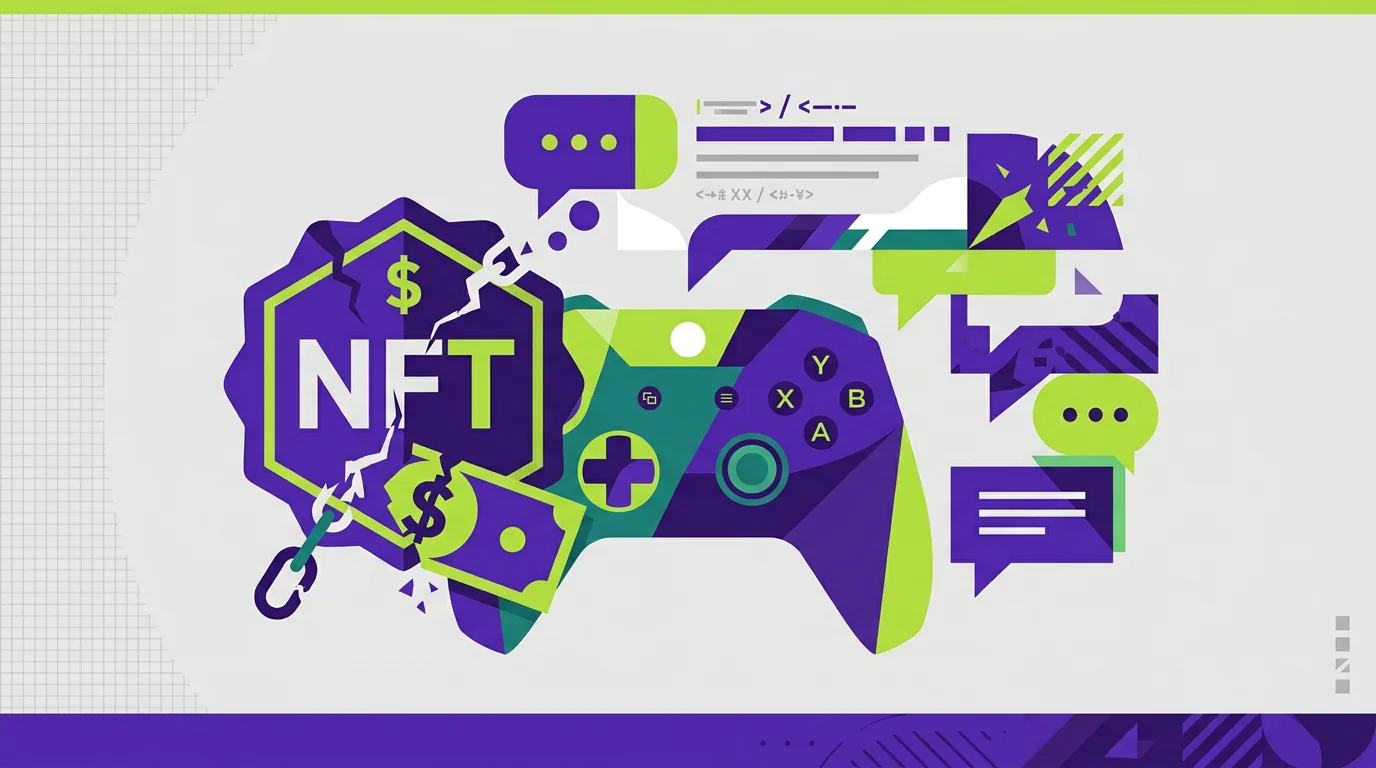
It is May 2026. We are three years out from the 2023 collapse of essentially every major gaming-NFT pitch deck, two years out from Ubisoft's quiet Quartz wind-down, eighteen months out from Square Enix's last public commitment to blockchain in the AAA pipeline, and twelve months out from the Animoca rebrand. It is a reasonable time to do an honest status check on what is actually happening in NFTs-and-gaming, free of both the original hype and the post-crash schadenfreude.
What survived
Less than the true believers claim. Gods Unchained is still running, still profitable in a niche way, and still adding cards on the schedule its remaining playerbase expects. Splinterlands continues to function. The handful of mid-sized projects that defined the play-to-earn era (Pegaxy, Thetan Arena, a couple of others) survive at a fraction of their peak DAU but are not zero. The pattern that connects the survivors is the same: small, dedicated audience, no AAA marketing budget, no Web3 evangelism in the marketing copy.
Tangentially, three professional-grade marketplaces for legacy in-game items (CS skins, Magic Online cards, Steam community items) have quietly adopted NFT-like backend infrastructure for provenance reasons. They do not call it NFT in their marketing, because the brand association is poisonous. They use the technology. This is the bit nobody talks about, and the most interesting consequence of the whole episode.
What died
The AAA gaming-NFT pitch. The major-publisher metaverse pivot. The play-to-earn category as a viable economic model. Pretty much every project that pivoted from a working game to a token-and-marketplace overlay between 2021 and 2023.
The death of play-to-earn is the most important one. The model was empirically broken — the unit economics relied on perpetual net-new player inflow funded by veteran-player extraction — and the people who said so in 2021 were right. It is worth remembering, looking at the survivors, that the survivors are the ones who never went near play-to-earn in the first place.
What changed silently
Two things, neither of which made headlines. First, the underlying chain-and-wallet infrastructure improved significantly in the post-crash period. Polygon's gaming-focused L2 is now genuinely usable; Immutable's order-matching engine is fast enough that the original UX objections (slow trades, awkward signing) are mostly resolved. None of this is being marketed because the audience that cared about it has dissipated. Second, the secondary market for legacy in-game items (the CS-skin economy, the Magic Online inventory market, etc.) is now bigger than the entire 2021 NFT-in-gaming primary market ever was. It works on rails that look very similar to NFT infrastructure. Nobody talks about it because it is unsexy.
The lesson, if there is one
The honest read on three years of NFT-in-gaming is that the believers were wrong about the timeline and the wrong about the categories, but not wrong about the underlying utility of provenance-tracked digital items. The crash happened because the marketing got ahead of the engineering by about four years. The marketing has now stopped, and the engineering has caught up. Whether the cycle restarts in three years' time, in some new form, with a new vocabulary that does not include the word "NFT", is the question worth watching. My guess is yes. My guess is also that the next iteration will be much smaller, much more boring, and much more useful.