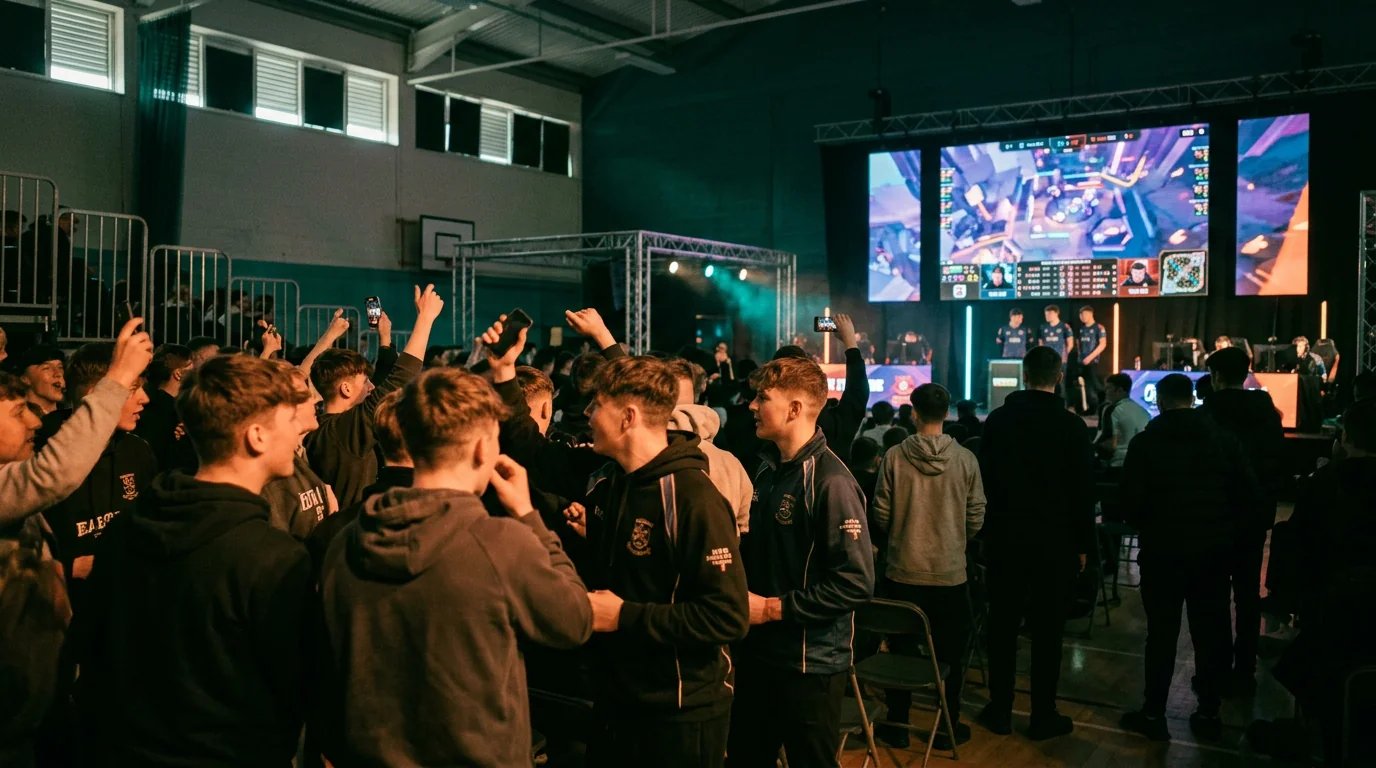

The British Esports Federation, founded in 2016, is the closest thing the UK currently has to a national governing body for competitive gaming. Its school-level engagement work is genuinely good — measurably so, with the British Esports Champs growing year-on-year and reaching schools that traditional governing bodies historically have not — and it deserves more credit than it gets for that. What it does not do, because the original mandate did not include it, is the harder federation work that the country actually needs.
What a national governing body actually does
For comparison, the FA does seven discrete things that any properly functioning national governing body in any sport tends to do: it sets technical standards, accredits coaching and refereeing, runs talent pathways, owns the national team programme, negotiates collectively with broadcasters and venues, represents the sport to government and regulators, and runs domestic discipline. The British Esports Federation does versions of two of these (school pathways, government representation), partial versions of two more (coaching accreditation in slow progress, talent pathways via school competitions), and effectively nothing in the other three.
Specifically: no collective venue framework, no collective broadcast framework, no domestic discipline structure for competitive integrity issues that fall outside individual publisher TOS enforcement. None of these are easy. All of them are needed.
The venue problem
The first practical consequence of the absent federation work is the venue problem. Any UK tournament wanting a thousand-seat venue currently has to negotiate one-off with the conference-centre and arena market, which means costs are roughly double what they would be in Poland or Germany, and lead times are roughly three times longer. A federation with a recurring partnership with two or three venue groups could, almost overnight, cut costs and lead times for the entire ecosystem. Nobody is doing this. Nobody owns the brief.
The broadcast problem
Second consequence: no collective broadcast framework. Sky, BT, ITV and Channel 4 all have small-to-medium esports footprints. Each negotiates separately with each tournament organiser. A federation broker — modelled on the equivalent role for boxing or motorsport — could meaningfully consolidate that fragmented inventory and present a single channel-of-channels proposition to advertisers. Again, the brief is unclaimed.
The integrity problem
Third consequence: the integrity gap. Match-fixing investigations in UK competitive gaming currently rely entirely on individual publisher enforcement (Riot, Valve, Psyonix), which means the institutional memory does not persist across games, the standard of evidence is inconsistent, and there is no UK-domestic right of appeal. A federation-run integrity unit could fix all three of these. The Australian and German federations have both built versions of this in the past four years. The UK has not.
Where the gap actually is
The British Esports Federation has neither the budget nor the original mandate to do the venue, broadcast, and integrity work. Its DCMS-routed funding is structured around its school-level remit. The harder federation work would require either a separate body, a significantly expanded mandate plus matching funding, or a private-sector funding consortium of the kind that does not currently exist.
None of this is a criticism of the Federation as it currently operates. It is, however, a criticism of the structural assumption that the school-level body is the same thing as a national governing body. It is not. The UK needs the second body, and it needs someone with the political capital to actually convene it.